


Q4 2025 enforcement update: Other jurisdictions rise as the U.S. goes quiet
In terms of regulatory enforcement, Q4 2025 was a tale of two sides. As the U.S. regulators went quiet under the weight of the longest government shutdown on record – 43 days – other international regulators remained busy.
The APAC region, in particular, stood out. We saw landmark fines, courts willing to recalibrate penalties upward, and a regulator signaling clearly and repeatedly that enforcement is being used unapologetically as a deterrent. Other jurisdictions remained active too, closing out a mix of insider trading, market manipulation, and systems and controls cases as the year drew to a close.
In Q4 2025, we saw 19 enforcement actions:
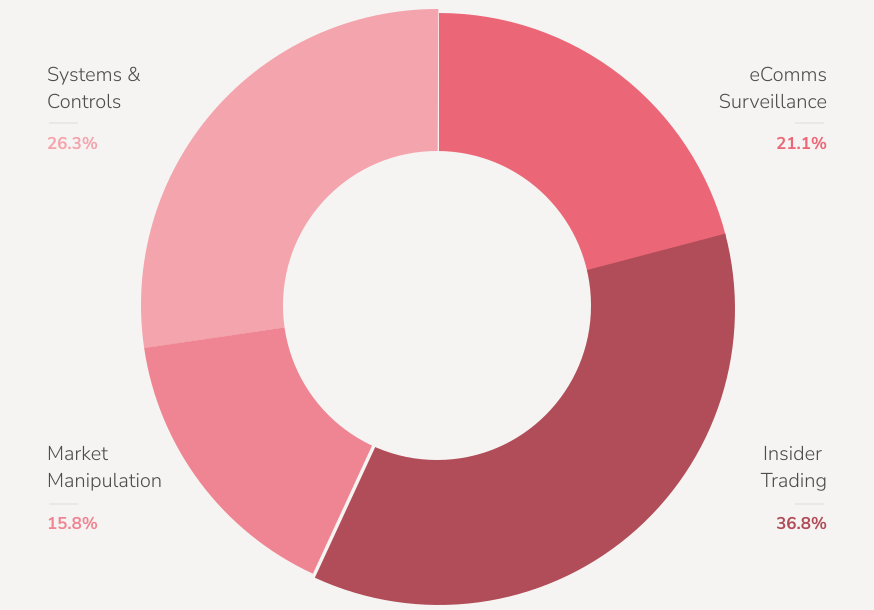
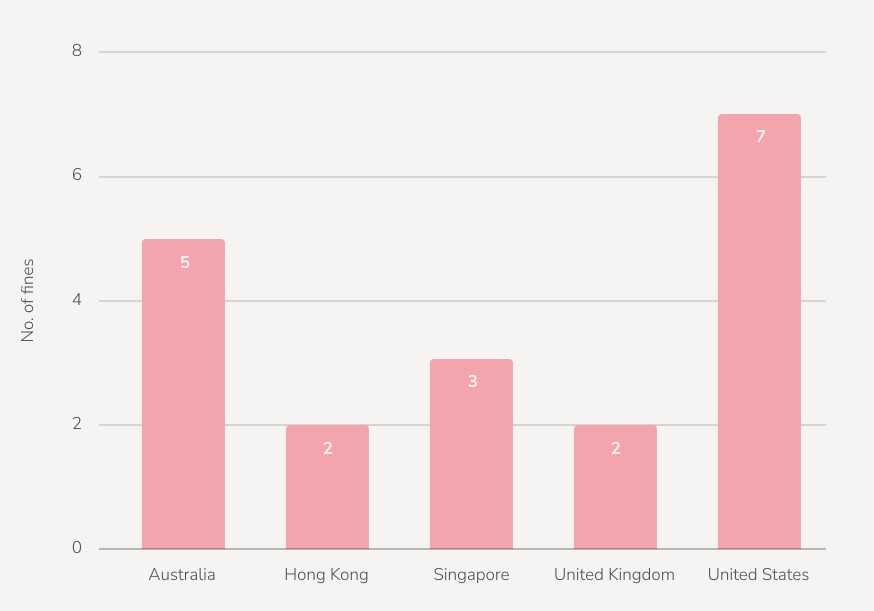
Across 5 jurisdictions:
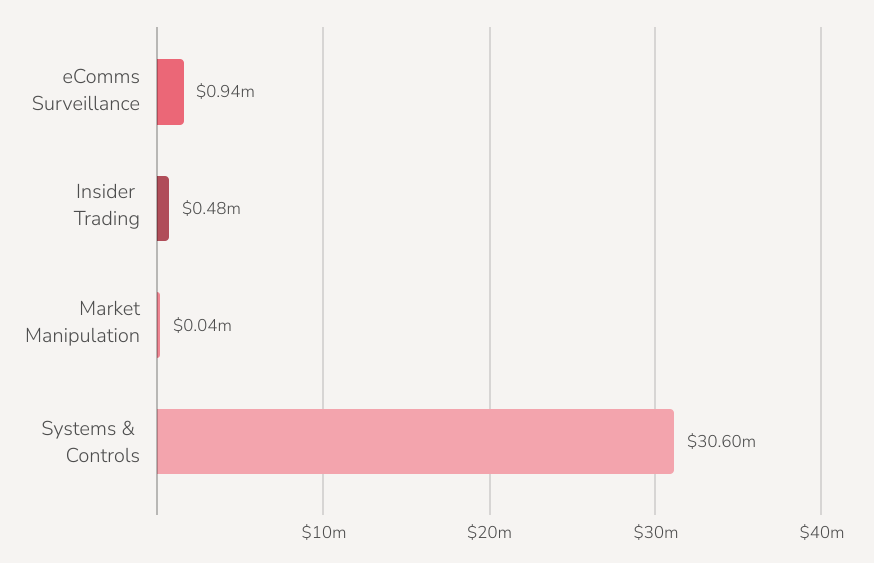
Totalling $32.1 million:
U.S.: FINRA zeroes in on supervision and surveillance execution
While we saw no enforcement from the SEC and CFTC, FINRA’s enforcement this quarter leaned heavily into supervision, surveillance, and communications governance, or a lack thereof.
On personal account dealing oversight, Canaccord Genuity Wealth Management was fined after failing to review associated persons’ securities transactions for potential insider or manipulative trading over several years. The firm outsourced the review to an affiliate but that review was limited (focused on insider trading only), and the Canaccord senior management had no effective oversight of the affiliate’s work, leaving gaps such as detecting trading ahead of customers.
FINRA also targeted weak supervision, in which case an individual falsely marked exception reports as “reviewed” in batches without actually evaluating thousands of transactions for potential manipulative trading, a reminder that regulators place equal emphasis on the quality of the human in the loop as they do the systems that support them.
Failures in eComms surveillance also persisted. Ally Invest was fined $850,000 for failing to preserve 22.6 million business-related electronic communications and failing to review ~521,000 communications. Other cases reinforced the same theme: personal devices, outside email, deletions, and weak capture controls continue to generate enforcement exposure
UK: The FCA focuses on insider trading
FCA enforcement this quarter focused on individual accountability in insider dealing. There were two cases of note to explore in the UK in Q4.
In one, the FCA charged a former investment banker involved in advising GCP Student Living PLC on a potential takeover, alleging he leaked inside information to a close associate. That associate traded in shares and spread bets, generating profits of almost £70,000, with the conduct dating back to 2021.
In another case, an advisor used advance knowledge of an ITM Power PLC announcement to avoid the impact of a sharp market move: he sold 125,000 shares worth £124,287 the day before, then bought back 180,000 shares worth £140,700 after the share price fell by around 37%, generating a gain of £26,575.
APAC: ASIC continues to ramp up enforcement
ASIC recently released its 2026 enforcement priorities, with market manipulation and insider dealing featuring prominently. The language was clear and deliberate. ASIC is increasingly positioning enforcement as a primary mechanism for upholding market integrity and maintaining the standards of transparency expected of Australian capital markets. That intent is clearly reflected in the data from Q4 2025.
Last quarter, the standout case was the combined AUD 240 million levied against ANZ for a range of issues tied to retail and institutional markets and trading misconduct. In Q4, the penalty for ANZ’s inaccurate reporting of secondary bond market turnover data was increased by a further AUD 10 million.
This brings the combined penalties related to institutional and market misconduct to AUD 135 million. Only the additional AUD 10 million uplift is captured in this quarter’s enforcement data; the remainder was reflected in last quarter’s figures. Even so, the increase reinforces ASIC’s willingness — and the court’s support — to increase penalties where market integrity failures are viewed as particularly pervasive or inexcusable.
Macquarie Securities and short sale misreporting: a data integrity failure with market abuse implications
ASIC’s action against Macquarie Securities (Australia) Limited marks a significant escalation in regulatory scrutiny of regulatory data quality. This is ASIC’s first ever short sale reporting case, culminating in a AUD 35 million penalty.
Between 2009 and 2024, Macquarie Securities misreported at least 73 million short sales, with ASIC estimating the true figure may be as high as 1.5 billion. The errors spanned more than 14 years, impacted over 300 securities, and in some instances distorted published short sale volumes by more than 50%. The failures were systemic, driven by long-standing systems weaknesses, inadequate supervisory procedures, insufficient technical resources and deficient risk management, most of which went undetected despite prior internal reviews.
This is not a market abuse case in the traditional sense. There are no allegations of insider trading or manipulative intent. However, the conduct directly undermined the transparency mechanisms that regulators and market participants rely on to assess sentiment, detect misconduct, and understand price movements. Short sale data is a foundational input for surveillance, risk analysis, and public confidence, particularly during periods of market stress.
Individual accountability remains the enforcement backbone in Singapore and Hong Kong
Elsewhere, in Singapore and Hong Kong, enforcement activity skewed more toward traditional market abuse, and regulators continued to demonstrate a willingness to pursue individuals for relatively contained but clear-cut misconduct.
In Singapore, MAS imposed civil penalties for insider trading that hinged on access to specific, market-moving information. One case involved the former managing director of Alpha Energy Holdings, who sold 2,413,300 shares via his parents’ accounts while in possession of non-public information.
Another involved a head of margin at a broker who learned of a corporate sale and the intended price ahead of announcement, then traded in both the parent (Tee International) and subsidiary (Tee Land), including purchasing three million shares in the parent ahead of the deal being made public.
In Hong Kong, the SFC secured custodial outcomes. One former corporate services executive received two months’ imprisonment for insider dealing linked to privatisation events, alongside financial orders reflecting losses avoided. Another individual received eight months’ imprisonment for false trading.
The broader signals
Q4 2025 underscored just how uneven enforcement momentum can be, and why firms should be careful not to mistake temporary silence for regulatory retreat. The U.S. slowdown was temporary, not strategic, while other jurisdictions used the quarter to reinforce expectations with clarity and force.
The most consistent signal this quarter was the elevation of control effectiveness over intent. From ASIC’s upward recalibration of penalties to its first-ever short sale reporting case, enforcement is increasingly focused on whether firms can demonstrate that systems, data, and supervisory processes work as intended.


